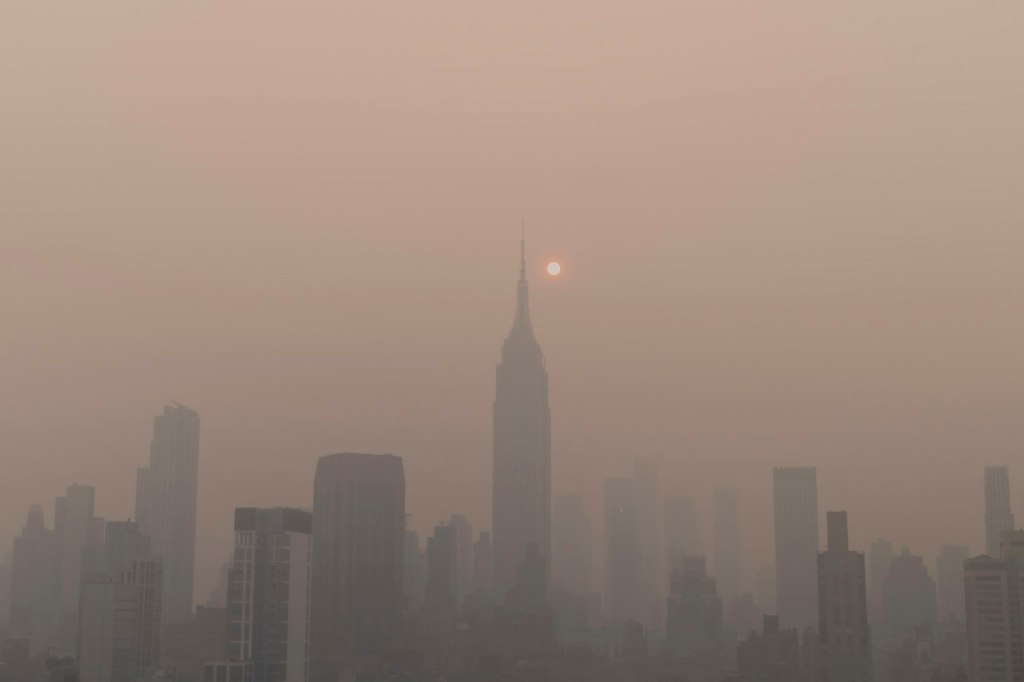
You can plan a big-city trip down to the last award seat and hotel suite, and still land somewhere the skyline disappears into a gray-brown haze by mid-morning. For frequent travelers, polluted air is one of the few trip conditions you can’t upgrade your way out of. You breathe the same air as everyone else on the sidewalk, and if you go for your usual morning run, you breathe a lot more of it.
That is why the Points Capital team skips outdoor runs in polluted big cities. We’re concerned about what dirty air does to the lungs and heart, so on those trips we lean on the basics instead: clean eating, fresh air when we can find it, plenty of water, good sleep and staying active indoors. Recently we’ve also been reading what Dr. Rhonda Patrick of FoundMyFitness has said about air pollution and a compound found in broccoli sprouts called sulforaphane.
Why polluted air matters, even on a short trip
Air pollution is not a niche problem. According to the World Health Organization, about 99% of the world’s population lived in places that did not meet WHO air quality guideline levels in 2019. The WHO estimates outdoor air pollution caused about 4.2 million premature deaths that year, and most of them were from heart disease and stroke, with lung conditions making up much of the rest. Fine particles are the main culprit.
A few days in a smoggy city is very different from living there for years, and those numbers describe long-term, population-wide risk. Still, it’s a good reason to be thoughtful about how much polluted air you choose to breathe hard while you’re away.
What Dr. Rhonda Patrick has discussed about sulforaphane
Dr. Patrick, a researcher who hosts the FoundMyFitness podcast, has returned to sulforaphane many times. In a 2020 conversation with researcher Dr. Jed Fahey, she described air pollution as a growing problem tied to low-grade chronic inflammation, and said she eats broccoli sprouts herself partly because she lives near a busy street. Talking about a clinical trial in China, she said: “It was a 60% increase in excretion, which is just phenomenal.”
Her sulforaphane topic page explains the basics. Broccoli sprouts are rich in glucoraphanin, a precursor compound. It turns into sulforaphane when it meets an enzyme called myrosinase, which is released when the plant is chewed or chopped. That enzyme is sensitive to heat, so how you prepare the food matters. In a 2022 clip, Dr. Patrick also points out what we still don’t know. The effect probably depends on how much pollution a person is exposed to, and it isn’t clear what happens with ongoing exposure over time.
The study behind the headline
The research she refers to is a randomized clinical trial published in Cancer Prevention Research in 2014 (Egner and colleagues). Researchers enrolled 291 adults in He-He Township, Qidong, in China’s Jiangsu Province, an area with heavy exposure to airborne pollutants. For 12 weeks, participants drank either a broccoli sprout beverage or a placebo each day.
Compared with placebo, the sprout group excreted about 61% more of a benzene breakdown product and about 23% more of an acrolein breakdown product in their urine. A third pollutant, crotonaldehyde, showed no significant change. The increase showed up on the first day measured and lasted through the trial.
Here are the important caveats:
- The study measured urine markers, not health outcomes. It didn’t show fewer heart attacks, lung problems or any other disease.
- Participants drank a concentrated, standardized beverage. That isn’t the same as adding a few sprouts to a hotel salad.
- The authors noted that people converted the compound very differently, and that air pollutants weren’t measured directly.
- Participants lived in a rural, polluted region of China, not a U.S. or European city, and most of them were women.
The findings are interesting and worth following, but they’re preliminary. They are not a license to jog through smog.
A practical playbook for polluted-city trips
Before you go
- Check the forecast for your destination. EPA’s AirNow explains the Air Quality Index: 0–50 is Good, 101–150 is Unhealthy for Sensitive Groups, 151–200 is Unhealthy, and anything over 200 is Very Unhealthy or Hazardous.
- When you book, look for a hotel with a real gym, or one near an indoor pool or fitness studio.
- If you have asthma, heart or lung conditions, or you’re pregnant, ask your doctor how to plan for poor air before you travel.
During the trip
- Check the AQI each morning. AirNow notes that air quality changes through the day, so even a bad day can have better windows.
- Move hard workouts indoors. A hotel treadmill or bike, bodyweight circuits in your room, or a day pass at a local gym all keep you active without heavy breathing next to traffic.
- Ask about air purifiers. Some hotels can bring one to your room. EPA’s guide to air cleaners notes that many portable units use HEPA filters to remove a high share of particles. It advises sizing a unit by its clean air delivery rate (CADR) and avoiding devices that intentionally produce ozone. EPA also says no air cleaner removes every pollutant.
- Eat simply and well. Load up on vegetables, including cruciferous ones like broccoli, and add broccoli sprouts when you find them at a market or salad bar. Drink plenty of water.
- Protect your sleep. It’s the foundation for everything else on a long trip.
After you’re home
- Get outside for walks or runs in cleaner air, and settle back into your normal sleep schedule.
- If you’re curious about sulforaphane supplements, which Dr. Patrick discusses on FoundMyFitness, talk to your doctor first. Her topic page notes that supplement quality varies and that the best source and dose haven’t been settled.
Our take
Broccoli sprouts are an easy, low-cost food to add to your plate, and the Qidong trial is one of the more interesting human studies linking a food compound to how the body handles certain air pollutants. But the strongest moves are still the boring ones. Check the AQI, take your workout inside when the air is bad, sleep well, drink water and eat real food. No sprout cancels out a hard run along a smoggy highway, so we’ll keep doing our running on the hotel treadmill.
Sources
- FoundMyFitness: Sulforaphane and benzene detoxification (relevance in smokers and for air pollution), with Jed Fahey
- FoundMyFitness: Sulforaphane boosts detoxification of air pollutants benzene and acrolein
- FoundMyFitness: Sulforaphane topic page
- Egner et al., “Rapid and Sustainable Detoxication of Airborne Pollutants by Broccoli Sprout Beverage,” Cancer Prevention Research, 2014 (PMC)
- WHO: Ambient (outdoor) air quality and health
- AirNow: Air Quality Index (AQI) Basics
- AirNow: Using the Air Quality Index
- EPA: Guide to Air Cleaners in the Home
This article is for general information only and is not medical advice. Talk to your doctor before changing your diet, exercise, sleep or supplement routine.


Leave a Reply